

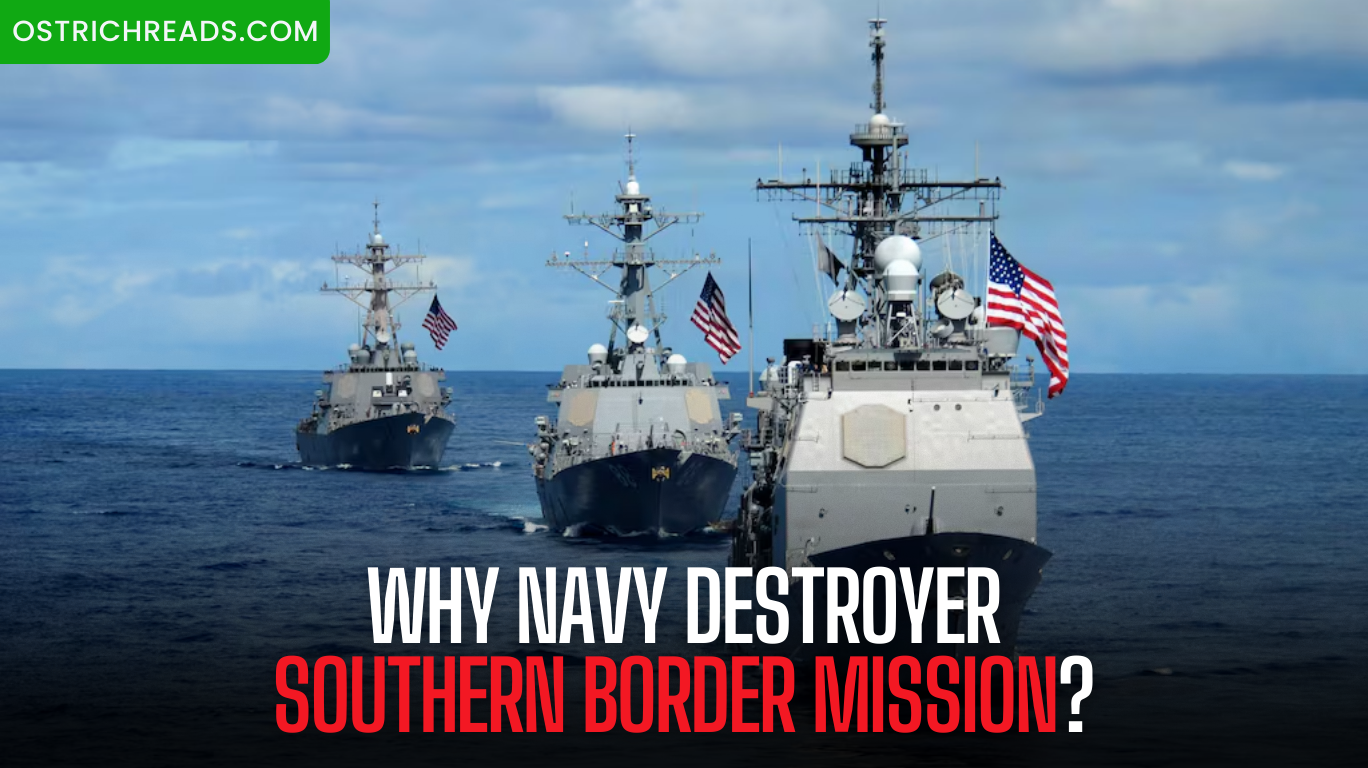

In 2025 and early 2026, the United States Navy launched a highly visible and strategic operation, now widely referred to as the Navy destroyer Southern Border mission. For the first time in recent history, Arleigh Burke-class guided-missile destroyers began conducting routine deployments near the U.S. southern maritime border to deter illegal immigration, disrupt drug trafficking routes, and reinforce territorial integrity.
Operating under U.S. Northern Command (USNORTHCOM), these missions blend naval firepower with law-enforcement authority—without violating domestic legal limits.
Why the Navy Launched the Southern Border Mission
The mission was initiated to address growing concerns over:
- Maritime drug trafficking
- Transnational criminal organizations
- Seaborne illegal migration
- Use of low-profile smuggling vessels and narco-submarines
Unlike land-based border enforcement, the maritime domain requires long-range surveillance, mobility, and rapid interdiction, making Navy destroyers uniquely suited for the task.
Key Navy Destroyer Deployments (2025–2026)
Several destroyers have rotated through the navy destroyer southern border mission, often redeploying directly from high-intensity combat zones.
Deployment Timeline Table
| Destroyer | Hull Number | Deployment Area | Deployment Date |
|---|---|---|---|
| USS Gravely | DDG-107 | Gulf of America & Caribbean | March 2025 |
| USS Spruance | DDG-111 | Pacific (San Diego–Mexico region) | March 2025 |
| USS Stockdale | DDG-106 | Pacific | April 2025 |
| USS Cole | DDG-67 | Gulf & Caribbean | June 2025 |
| USS Sampson | DDG-102 | Pacific | June 2025 |
These rotations ensure a continuous naval presence without overstretching a single crew.
Mission Scope: What Navy Destroyers Are Actually Doing
The navy destroyer southern border mission is not about direct policing—it’s about detection, coordination, and interdiction support.
Core Objectives
- Detect and track smuggling vessels
- Disrupt maritime drug supply routes
- Support Coast Guard law enforcement actions
- Deter illegal maritime crossings
Destroyers act as floating surveillance hubs and command centers, feeding real-time intelligence to enforcement partners.
How the Mission Stays Legal: Posse Comitatus Explained
U.S. military forces cannot conduct domestic law enforcement due to the Posse Comitatus Act. To comply with the law:
- Destroyers embark U.S. Coast Guard Law Enforcement Detachments (LEDETs)
- NCIS Special Agents handle investigative and legal actions
- The Navy provides detection, tracking, and mobility—not arrests
This hybrid structure allows enforcement without violating federal law.
Advanced Capabilities Used in the Mission
Arleigh Burke-class destroyers bring unmatched technology to border security operations.
Tactical Advantages
- Aegis Combat System for wide-area radar coverage
- Long-range surface and air sensors
- MH-60R Seahawk helicopters for rapid interception
- Intelligence fusion across military and law-enforcement agencies
These tools allow detection of:
- Narco-submarines
- Low-profile “go-fast” boats
- Coordinated smuggling operations
Why Destroyers Are a Game-Changer at the Southern Border
Unlike smaller patrol vessels, destroyers can:
- Stay deployed longer
- Operate across vast maritime zones
- Coordinate multi-agency responses
- Transition rapidly from combat missions to security operations
This flexibility makes them ideal for modern border challenges that blend crime, migration, and international waters.
Strategic Message Behind the Mission
Beyond enforcement, the navy destroyer southern border mission sends a strategic signal:
- The U.S. is willing to deploy high-end naval assets for homeland defense
- Maritime routes are no longer low-risk pathways for traffickers
- Border security now includes blue-water capabilities
FAQs
What is the navy destroyer southern border mission?
It’s a U.S. Navy operation deploying guided-missile destroyers to support maritime border security, counter drug trafficking, and deter illegal seaborne immigration.
Can Navy destroyers make arrests?
No. Arrests and searches are carried out by Coast Guard LEDETs and NCIS agents embarked on the ships.
Why use destroyers instead of Coast Guard cutters?
Destroyers offer longer endurance, advanced sensors, helicopters, and command-and-control capabilities suited for wide-area surveillance.
Conclusion
The navy destroyer southern border mission represents a major evolution in how the U.S. secures its maritime frontier. By combining advanced naval technology with law-enforcement authority, these deployments close gaps long exploited by transnational criminal networks.
As threats become more sophisticated at sea, the mission signals a clear shift: border security now extends far beyond the shoreline.














Leave a comment